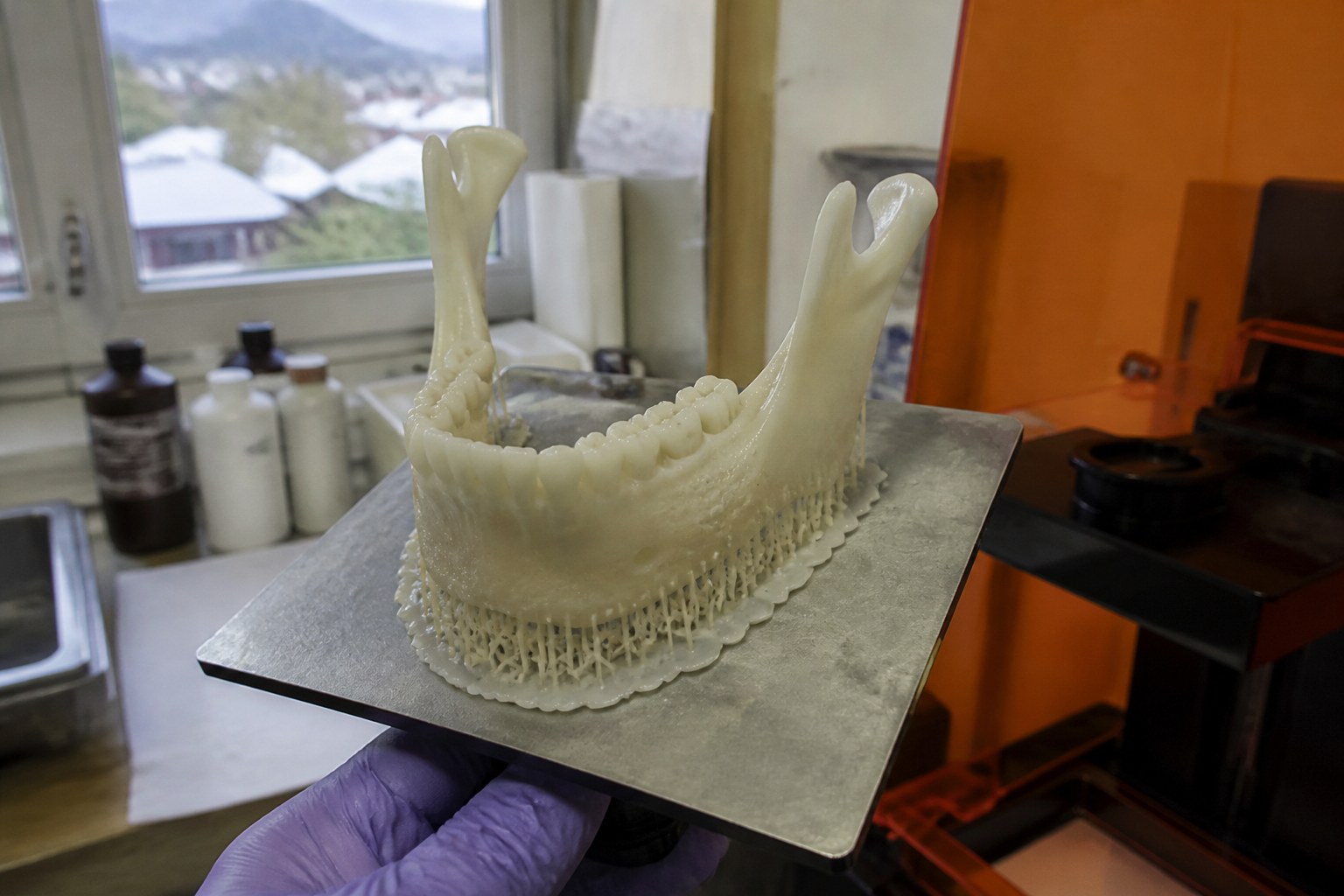
You are planning a mandibular reconstruction, or a skull base approach through bone that a tumour has already reshaped. A patient-specific model of that anatomy costs a few hundred francs. The operating room you will stand in costs money every minute it runs. Set those two numbers side by side and the question changes: not "can we afford a model?" but "what does the case cost without one?"
This article looks at the 3D printed anatomical model cost from both ends: what published data say about the minutes a model can save, and what actually drives the price you are quoted.
What an operating room minute costs
The most cited benchmark comes from California hospital financial filings. Childers and Maggard-Gibbons (*JAMA Surgery*, 2018) put the mean cost of OR time at $36 to $37 per minute in fiscal year 2014, of which $20 to $21 was direct cost, mostly wages and benefits.
The same group updated the analysis this year. Ashrafi, Maggard-Gibbons and Childers (*JAMA Surgery*, 2026) report a mean cost of $57.71 per minute across California hospitals for fiscal year 2022, a 54% rise since 2014.
Two cautions keep these numbers honest:
- They are Californian and in dollars. Your own hospital's figure will differ; finance departments usually have it.
- Saved minutes are not all saved money. Childers and Maggard-Gibbons point out that almost half of OR cost is indirect overhead, and that saving five minutes will have little effect on those expenses. What a shorter case really buys is capacity: staff hours, the next case starting on time, a list that does not overrun.
How many minutes can a model save?
The best-known cost analysis is Ballard et al. (*Academic Radiology*, 2020), which pooled published operative-time data in orthopaedic and maxillofacial surgery:
- Anatomic models: seven studies, a mean of 62 minutes saved per case, about $3,720 per case at the authors' reference of $62 per OR minute.
- Oral and maxillofacial models specifically: five studies, a mean reduction of 66 minutes.
- Surgical guides: 25 studies, a mean of 23 minutes saved.
A 2023 systematic review and meta-analysis in craniomaxillofacial surgery (Heron et al., FACE) covered 45 studies and 751 patients. Of the 19 articles that reported intraoperative time, 78.9% found a significant reduction when 3D printed constructs were used.
Read these as signals, not promises. Ballard and colleagues note that their sources were heterogeneous and that validation with institutional data is needed; the OR cost reference they used dated from 2005. A model is a powerful aid, not a universal replacement for experience, imaging and a good plan. It saves the most time where the anatomy is the source of uncertainty: the revision case, the distorted mandible, the sinus that does not match the textbook.
Do the arithmetic for your own case
Put your hospital's cost per minute next to the quote. At the 2026 California mean of $57.71 per minute, ten minutes of OR time is about $577. A model that removes one moment of hesitation in a long reconstruction, or lets you pre-bend a plate on the bench instead of in the field, does not have to save an hour to justify itself. If your cases rarely involve uncertain anatomy, the arithmetic may well say you do not need one, and that is a useful answer too.
What drives the price of a model
At MedForm3D, anatomical models start from CHF 450, and you receive a quote before anything is produced. Where a case lands above that depends on a few things.
- Segmentation effort. This is skilled time, and it scales with anatomy. In Ballard's institutional data, segmentation averaged about 101 minutes for a simple single-part model and about 143 minutes for a complex multi-part one, and total variable cost rose from $119 to $320. Distorted, post-surgical or low-contrast anatomy takes longer to get right.
- Scan quality. Thin, artefact-free CT or MRI slices segment cleanly. Metal artefact, motion or thick slices mean more careful manual work.
- Size and print time. A single temporal bone prints faster than a full skull or a mandible with the midface attached.
- Finish. Models come in white resin or clear resin. A clear model is only useful if you can see through it, so it is wet sanded and clear coated by hand after printing. That labour is part of the price.
- Number of parts. Separable segments or several pieces that must fit together add design and finishing time.
- Turnaround. Typical delivery is 3 to 5 working days after design approval. A 48-hour express service is available on request, subject to availability.
What the quote covers
The price is for the whole workflow, not just the print: you upload DICOM (CT/MRI) or STL data, the anatomy is segmented, you approve the design, and only then is the model printed, finished and delivered. Your approval step is where you check that the segmentation shows what you need to see.
Who pays for it
Reimbursement depends on your system and your payer. In the US, dedicated Category III CPT codes exist for anatomic models and guides; our post on CPT codes for 3D anatomical models explains what they cover and their limits. Elsewhere, many teams fund models from departmental budgets, case by case, on exactly the arithmetic above.
Final thought
A model's price is fixed and visible; its value sits in minutes, decisions and avoided surprises that are harder to see on an invoice. For a routine case it may not earn its keep. For the case where you cannot picture the anatomy from the scan, it usually does.
Upload your scan and get a quote for your case, or read more about models for surgeons.
This article is for informational purposes and is not medical advice.

